
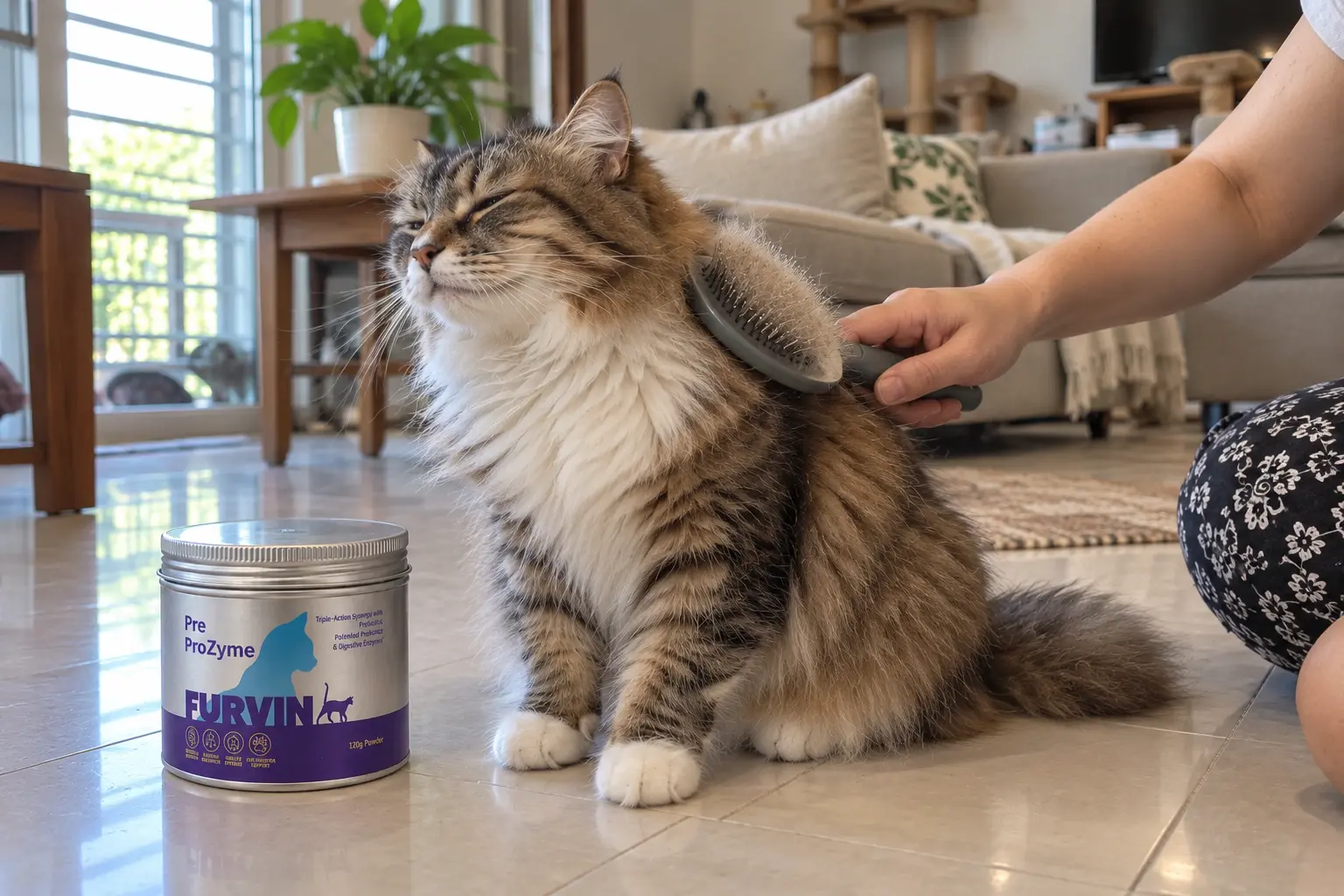
Hairball control is not about choosing between a brush, a paste or digestive support. Each acts at a different point—and the strongest daily routine connects all three.
The 20-Second Answer
- Brush outside: remove loose fur before your cat swallows it.
- Support inside: keep water, complete nutrition and appropriate fibre in the daily picture.
- Respond early: repeated retching or vomiting is not something to cover with more paste.
What Hairball Paste Can—and Cannot—Do
Many hairball remedies are lubricant- or laxative-style products intended to help swallowed hair pass through the digestive tract.[2][3] That is one useful job, but only one.
Paste does not:
- remove loose fur before grooming
- correct fleas, itching, stress or pain that may increase licking
- replace hydration and a complete diet
- support the digestive routine every day unless specifically directed
- clear a blockage once a cat is repeatedly vomiting or cannot keep water down
Never give a human laxative or improvise a dose. Cornell advises that laxatives should only be used with veterinary approval and supervision.[1]
The 3-Part Hairball Control Routine
1. Reduce the incoming fur
Brush in short, calm sessions with a tool suited to the coat. Long-haired cats may need more frequent attention because they can swallow a greater volume of fur during grooming.[1][2]
Two or three comfortable minutes that actually happen are more valuable than one long weekly struggle.
2. Support the normal route out
Most swallowed hair is meant to leave in the stool.[1] Water intake, a nutritionally complete diet and appropriate fibre all belong in this part of the plan.
Feline feeding studies have found that selected fibre-containing diets can change faecal hair excretion or faecally eliminated hairball counts under specific study conditions.[4][5] The effect depends on the fibre source, amount, complete diet and individual cat—“more fibre” is not automatically better.
3. Read the pattern, not one event
Record hairball episodes, brushing yield, stool consistency, appetite and unusual grooming for seven days. A repeated pattern tells you more than one isolated hairball.
Why Apple Fibre + Pumpkin Belong in the Conversation
Apple fibre and pumpkin do not dissolve hair. Their value is more practical: they strengthen the normal stool-passage side of the routine.
Apple fibre
Apple-derived fibre contains soluble and insoluble fractions. A controlled study in adult cats found dried apple pomace could be used as a fibrous dietary ingredient and documented dose-related changes in digestibility and faecal dry matter.[6]
That study did not test PreProZyme or hairball frequency. It supports the narrower point that apple fibre belongs in a digestive and stool-quality formula—not merely on the front of a label.
Pumpkin
Pumpkin adds another familiar, food-based fibre source. In PreProZyme, it complements apple fibre rather than pretending to be a standalone hairball cure.
Why PreProZyme Makes the Routine Easier
PreProZyme is built for the inside half of hairball care. One measured daily formula brings together:
- Apple fibre + pumpkin for the fibre and stool-passage side
- 5.5 Billion CFU probiotics for the intestinal microbial community
- Inulin prebiotic to support the microbial environment
- Five digestive enzymes to support the breakdown of food components
That combination is the advantage over buying a probiotic-only powder or waiting for the next hairball before reaching for paste. It turns digestive support into a habit you can repeat and evaluate.
Make It a 5-Minute Daily Habit
- Brush: two to three calm minutes, especially through dense coat areas.
- Feed: mix the measured PreProZyme serving into familiar food and follow the current pack directions.
- Hydrate: keep fresh water easy to reach; wet food can also contribute to total water intake.
- Check: glance at the coat, appetite and litter box before the day moves on.
Consistency is the selling point because consistency is also what makes a routine readable. You can see whether the overall pattern is improving instead of reacting to every isolated episode.
When a Hairball Is No Longer a Home-Routine Problem
Contact a veterinarian promptly if your cat has repeated unproductive retching, repeated vomiting, cannot keep water down, stops eating, becomes unusually quiet or weak, appears painful, or strains without passing stool.[1][3]
PreProZyme is daily wellness support. It cannot dissolve a formed hairball or clear an obstruction.
Frequently Asked Questions
Does hairball paste work?
Is PreProZyme a replacement for hairball paste?
No. They have different roles. Paste is generally used as an occasional passage aid; PreProZyme is designed as daily digestive-wellness support with apple fibre, pumpkin, probiotics, inulin and digestive enzymes.
How do apple fibre and pumpkin help with hairballs?
They support the fibre and stool-passage side of the routine. Most swallowed fur is meant to leave in the stool. They do not dissolve hair, and finished-product hairball outcomes have not been clinically established for PreProZyme.
How often should I brush my cat?
Match the frequency to coat length, shedding and your cat's tolerance. Long-haired or heavily shedding cats often benefit from brief daily sessions. Stop before the experience becomes a struggle.
Can I use PreProZyme every day?
Yes. PreProZyme is designed for daily digestive wellness. Introduce it gently, use the measured serving on the current pack and keep the rest of the routine stable enough to judge the pattern.
What if my cat keeps coughing but no hairball comes out?
Do not assume every cough is a hairball. Record a short video and speak with a veterinarian, especially when the episodes repeat or breathing looks difficult.
The Bottom Line
Hairball control works best as a system, not a rescue product.
Brush outside. Support inside. Pay attention to the pattern.
Paste may help at one point in the journey. PreProZyme earns its place by making the fibre, prebiotic, probiotic and enzyme side of the daily routine easier to keep.
One daily formula for the inside half of hairball care.
References / Sources
- The Danger of HairballsCornell University College of Veterinary Medicine
Explains normal hairball formation, warning signs, brushing and the need for veterinary supervision when laxatives are used.
- A Hairy DilemmaCornell Feline Health Center
Discusses grooming, long-haired-cat risk and the role of hairball remedies within a broader prevention routine.
- Vomiting in CatsMerck Veterinary Manual
Reviews brushing, passage aids and warning signs that warrant veterinary assessment.
- Influence of the dietary fibre levels on faecal hair excretion after 14 days in short and long-haired domestic catsVeterinary Medicine and Science (2015)
A controlled 21-cat study of fibre-containing diets and faecal hair excretion; outcomes differed by coat length and diet.
- Sugarcane fibre may prevents hairball formation in catsJournal of Nutritional Science (2014)
A 32-cat diet study evaluating two insoluble fibre sources and faecally eliminated trichobezoars under its specific conditions.
- Evaluation of dried apple pomace on digestibility and palatability of diets for catsRevista Brasileira de Zootecnia (2020)
A controlled adult-cat feeding study of dried apple pomace as a fibrous ingredient; it did not test hairball frequency or PreProZyme.