
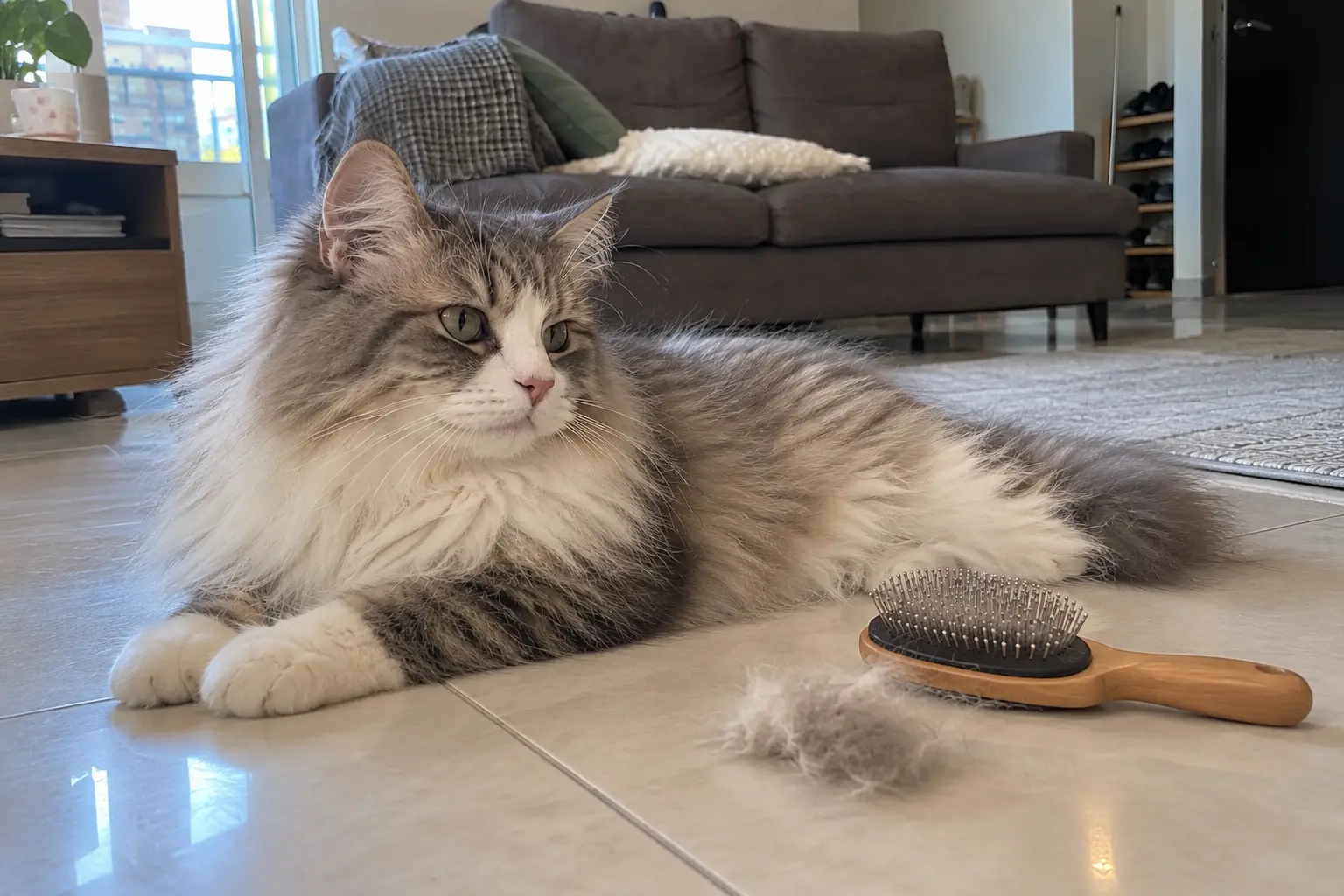
You cleaned the sofa yesterday.
Today, there is fur on it again.
Your clothes collect hair. Your bedsheets collect hair. And after one grooming session, the brush sometimes looks like it could make another cat.
So naturally, you start wondering:
The amount of fur you see is only part of the story.
A better question is:
Cats naturally shed old hair as new hair grows. In veterinary references, shedding without obvious bald patches may simply be part of normal coat replacement. But hair loss combined with redness, itching, inflammation or visible thinning deserves closer attention.[1]
The 30-Second Check
Normal shedding — or something more?
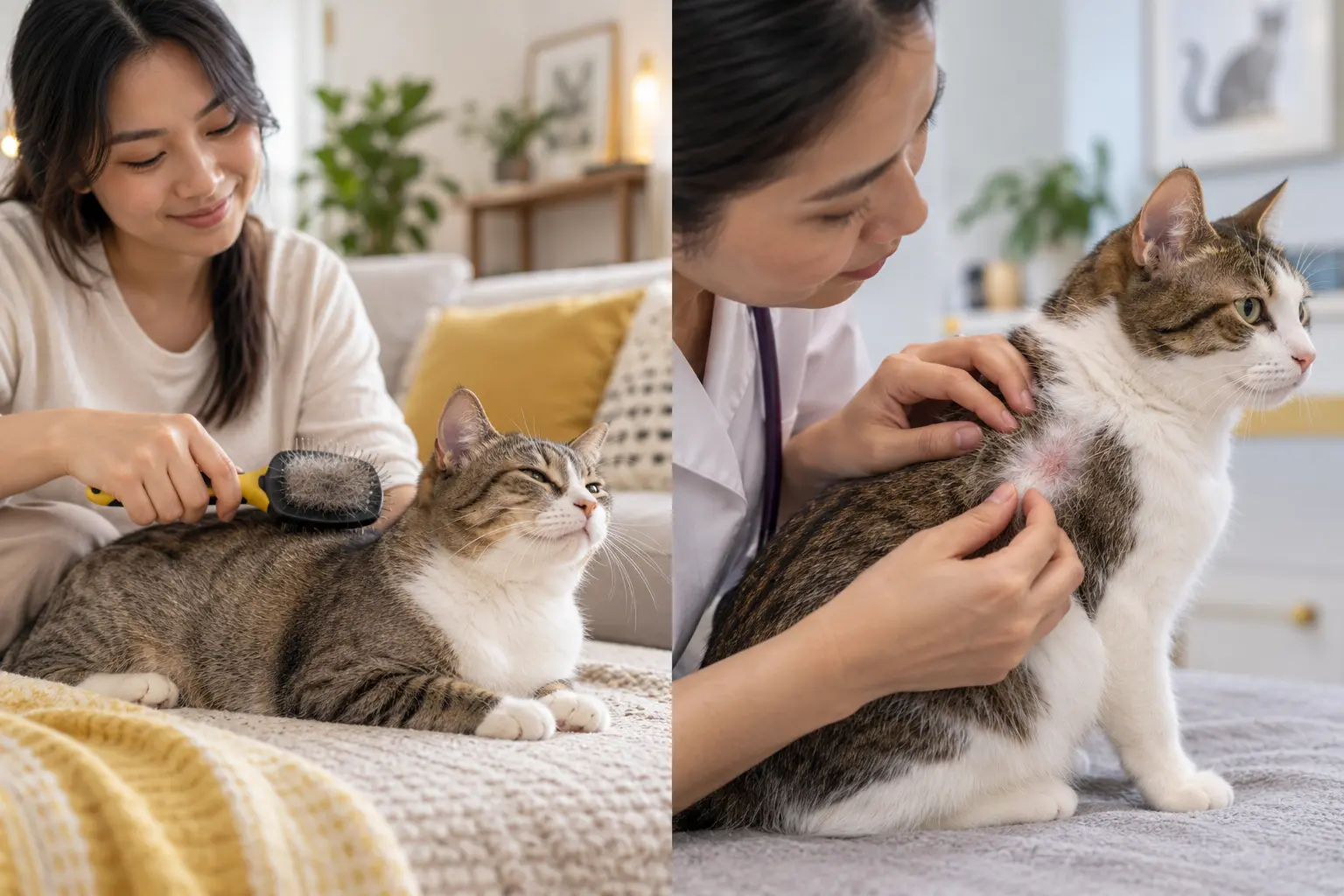
More likely normal shedding
Your cat may simply be going through normal coat turnover when:
- the coat still looks full and even
- skin underneath looks healthy
- there are no obvious bald areas
- loose fur appears mainly during grooming or around the home
- your cat is not constantly scratching or biting
- appetite and behaviour remain normal
Normal hair growth naturally involves old hairs being released as the coat renews itself.[1]
Look closer when you notice
- bald patches
- obvious thinning in one area
- excessive licking
- repeated scratching or chewing
- red or inflamed skin
- scabs or crusts
- broken hairs
- wounds
- sudden heavy dandruff
- a major change in coat texture
Parasites, allergies, infections, inflammation and other health conditions can all contribute to feline hair loss or skin disease.
Why Do Cats Shed?
A cat's coat is constantly renewing itself.
Individual hairs move through stages of:
growth → transition → rest → release → new growth
Environmental and biological factors can influence this process, including nutrition, hormones, temperature and light exposure.[1]
So the goal should never be:
Healthy cats are supposed to shed.
A more useful goal is:
5 Reasons Your Cat May Be Shedding More
1. Normal coat turnover
Sometimes there is no hidden problem.
Old hair simply has to make way for new hair.
If your cat still has:
- a dense, even coat
- healthy-looking skin
- no obvious itching
- no bald patches
- no other change in health
then the pile of fur on the brush may still represent normal shedding.[1]
Long-haired and dense-coated cats can also make normal shedding look much more dramatic simply because there is more visible hair to collect.
2. Your cat is grooming more than usual
Cats already spend a large amount of time grooming themselves.
Cornell notes that cats may spend roughly 30–50% of their day grooming.[3]
But normal grooming and overgrooming are very different.
Look for:
- repeatedly licking one location
- pulling or chewing fur
- hair becoming progressively thinner
- bald areas appearing
- irritated skin underneath
Possible reasons include itching, fleas, allergy, discomfort, pain or stress.
The important clue is change.
If a cat that normally grooms calmly suddenly starts obsessively working on one area, there may be more going on than ordinary coat maintenance.
3. Skin irritation, fleas or allergies
Sometimes the visible fur problem begins at the skin.
Cornell lists parasites, flea-bite allergy, food allergy and other allergic or infectious conditions among common causes of feline skin disease. Typical signs include scratching, excessive licking, redness, scaling and hair loss.
A common pattern can look like:
itching
↓
more licking and scratching
↓
hair damage
↓
thinning or bald areas
This is why skin observation should always be part of shedding management.
4. Nutrition
A healthy coat does not grow from the outside.
It has to be built from within.
Normal skin and hair growth depend on adequate nutritional intake, and veterinary references recognise significant nutritional deficiencies—particularly protein deficiency—as potential contributors to abnormal coat and hair loss.[1]
Cornell also notes that gastrointestinal disease or abnormal nutrient absorption can sometimes be reflected in skin health.
That does not mean adding random vitamins is the answer.
The foundation is still:
5. The Gut–Skin–Coat Connection
This is where shedding becomes more interesting than simply:
The digestive tract does much more than move food from one end of the body to the other.
It is involved in:
- food digestion
- nutrient availability
- the intestinal microbiome
- gut-barrier function
- immune signalling
- production of microbial metabolites
Modern feline research increasingly shows that changing the intestinal microbial environment can influence outcomes beyond stool alone.
A 2025 systematic review of probiotic, prebiotic, synbiotic and postbiotic research in cats found beneficial gastrointestinal effects across a number of studies, particularly in faecal consistency, while also noting that outcomes differ between interventions and study designs.[5]
More importantly for a coat-focused discussion, a controlled 2024 feline probiotic study measured hair condition alongside gastrointestinal and immune markers.
After 28 days, cats receiving the probiotic intervention had a significantly better hair-condition score than controls (p = 0.03). The same study also found changes in gut-barrier and immune-related measurements. It was a small study—five cats per group—but it demonstrates that probiotic intervention and coat condition are not biologically unrelated concepts.[6]
So can gut support be relevant to shedding?
Yes.
It should not be presented as the only factor behind every coat problem.
But digestive wellness, microbial balance and nutritional support can reasonably form part of a broader skin-and-coat strategy.
And this is exactly where FURVIN PreProZyme is positioned.
How FURVIN PreProZyme Supports Skin & Coat Wellness From the Inside
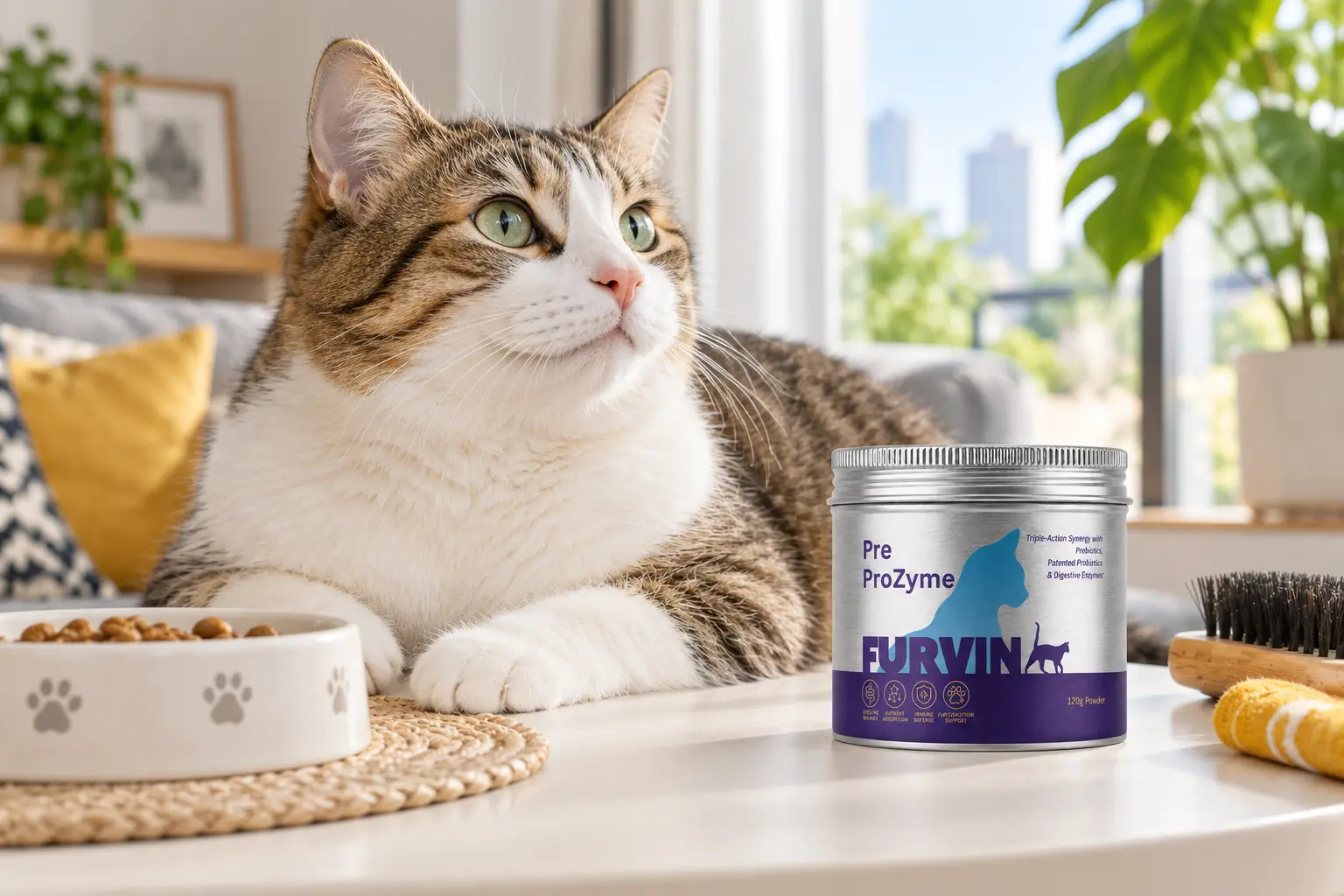
PreProZyme is not designed as a generic “vitamin for fur.”
Its formulation starts deeper:
FURVIN PreProZyme combines:
One Formula. Three Layers of Digestive Support.
1. 5.5 Billion CFU Probiotics
Every 5 g daily serving provides:
5.5 Billion CFU from five selected probiotic strains
And this distinction matters.
Probiotic benefits are not determined by CFU count alone.
Different strains can behave differently and produce different functional effects; recent veterinary literature continues to emphasise the importance of strain- and dose-specific probiotic effects.
FURVIN therefore selects its probiotic system based on more than:
The formulation uses selected strains chosen with strain-specific functional evidence relevant to digestive wellness and coat-related support, including shedding and swallowed-hair management.
For the cat parent, the important point is simple:
2. Inulin Prebiotic
Probiotics are only part of the equation.
PreProZyme also contains inulin, a prebiotic fibre.
A probiotic provides microorganisms.
A prebiotic helps provide substrate for the intestinal microbial ecosystem.
In a 2024 study involving healthy adult cats, dietary inulin altered faecal microbiota and increased secretory IgA during the intervention period.[7]
This gives PreProZyme another layer of support:
3. Five Digestive Enzymes
PreProZyme also combines:
Protease
Cellulase
Lipase
Bromelain
Papain
Cats naturally possess their own digestive enzymes.
PreProZyme's enzyme blend is designed to complement the digestive process, completing the third layer of the formula alongside probiotics and prebiotic support.
So rather than thinking about PreProZyme as only a probiotic powder, think of it as a multi-pathway digestive wellness formula.
Why Does This Matter for the Coat?
Because a healthy-looking coat is an output.
What you see on the outside depends on what the cat is able to maintain on the inside.
The coat exists within a bigger system involving:
nutrition
digestion
microbiome
skin health
grooming
overall health
A change in any one part of that system can influence what you eventually see in the fur.
That is why FURVIN's approach is:
What If My Cat Already Has a Skin Problem?
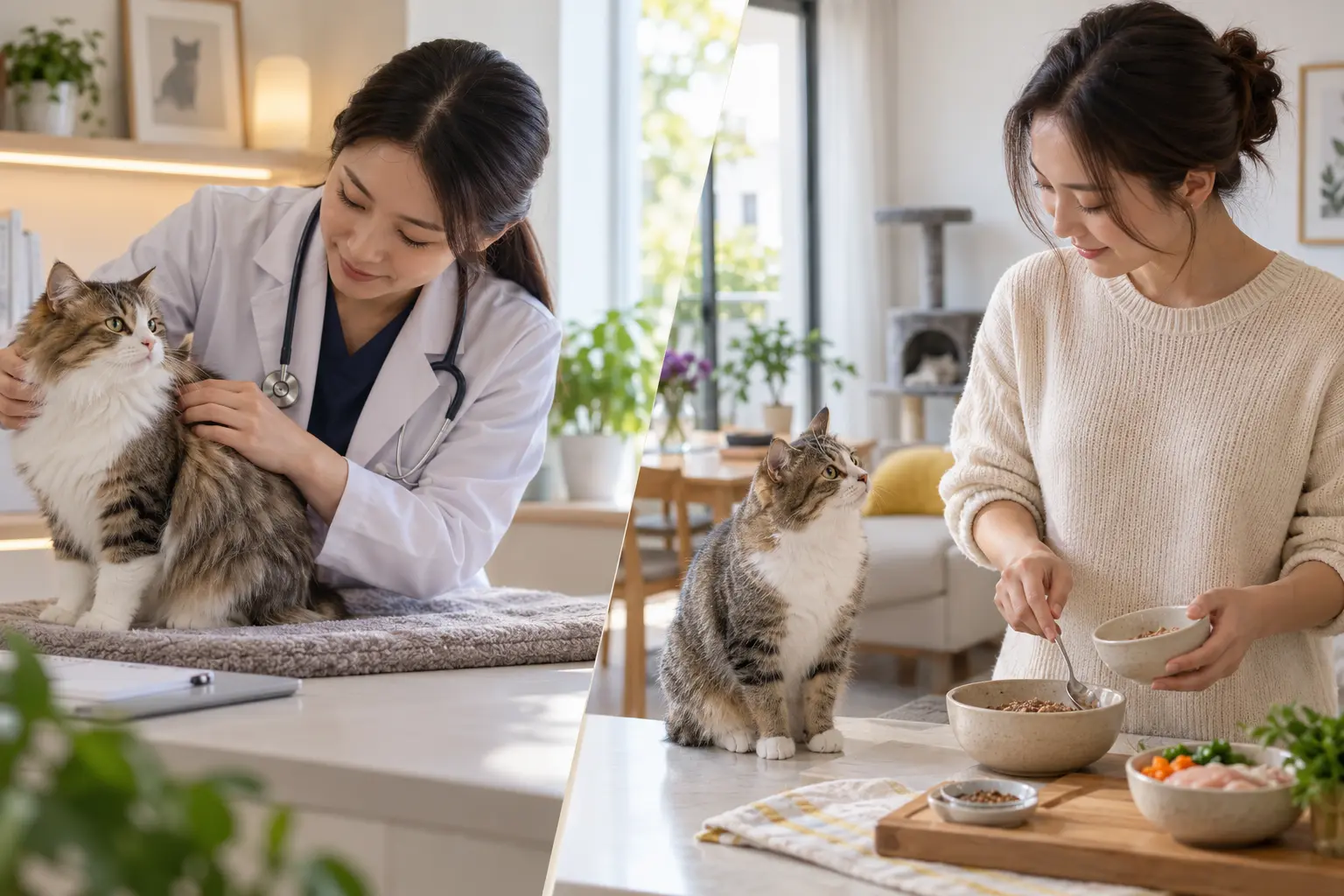
This is important.
A cat with a skin or coat concern can still benefit from digestive and nutritional support.
If the cat is experiencing:
- poor coat condition
- increased shedding
- excessive grooming
- swallowed loose hair
- hairball concerns
- digestive instability alongside a skin issue
PreProZyme can be considered as part of the cat's complementary inside-out wellness support.
Its role is to support:
Digestive wellness
Gut microbiome balance
Coat-condition support
Shedding support
Swallowed-hair management
Overall nutritional wellness
If a specific trigger such as parasites, infection or allergy is involved, that trigger may also need its own targeted management.
That does not make PreProZyme irrelevant.
It simply means the cat may benefit from support on more than one level.
This is the difference between treating only what you see and supporting the bigger system behind it.
Grooming Still Matters
Digestive support does not replace grooming.
In fact, the two approaches complement each other particularly well.
Brushing removes loose fur before the cat swallows it.
Cornell explains that cats swallow substantial amounts of loose hair while grooming; most passes through the gastrointestinal tract, while some can accumulate and form hairballs.[8]
So think of shedding management as:
OUTSIDE
Brush and remove loose fur
INSIDE
Support digestion, microbiome and swallowed-hair management
That is a much more complete approach than focusing on one side alone.
Try the 7-Day Shedding Check
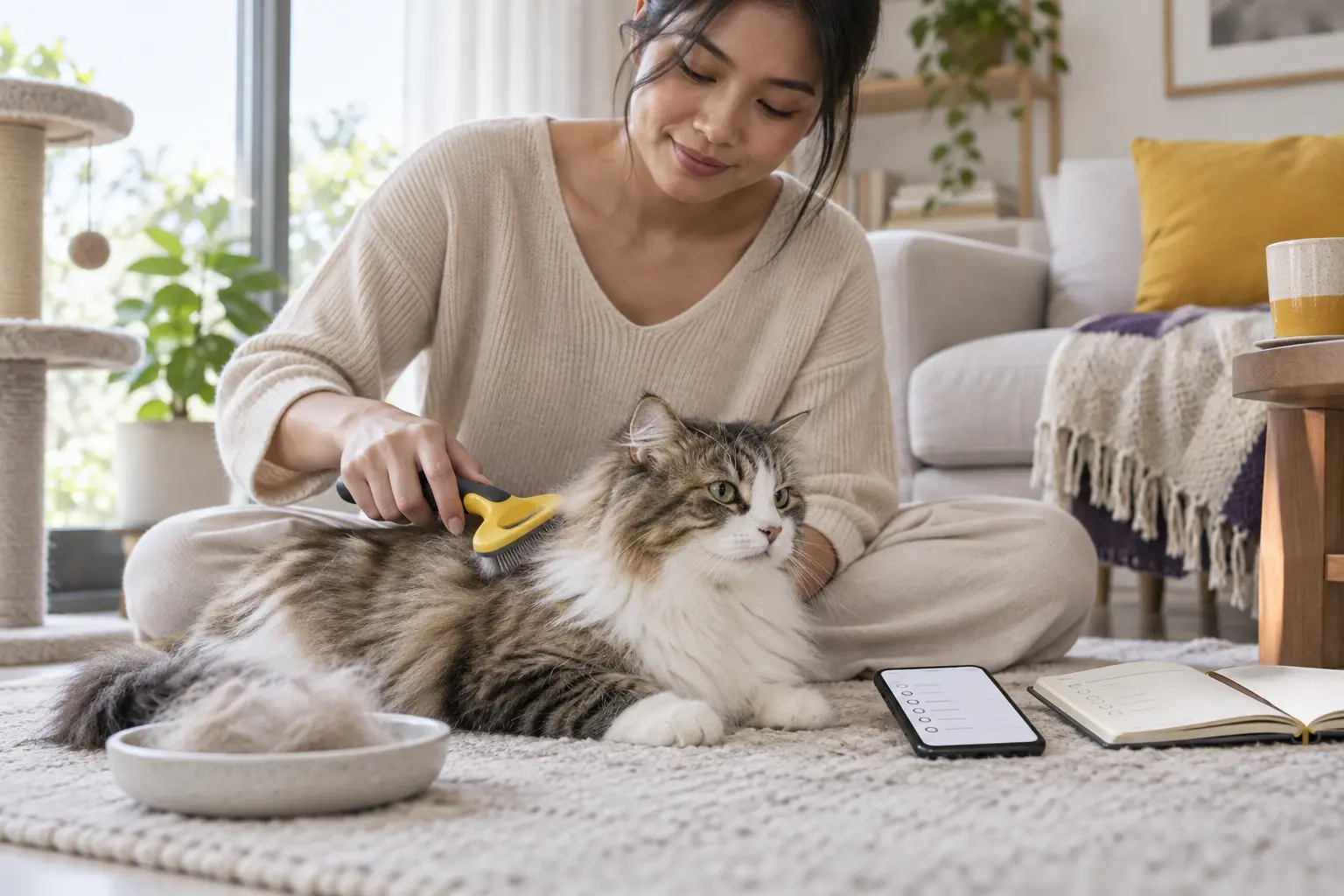
Not sure whether your cat is genuinely shedding more?
Track it.
Day 1
Take clear photos of:
- back
- sides
- areas that concern you
Every day for 7 days
Brush for roughly the same amount of time.
Observe:
- amount of loose fur
- scratching
- licking
- coat thickness
- skin condition
Also note:
- appetite
- stool
- vomiting
- energy
- behaviour
After one week, you have something much more useful than:
You have a pattern.
The FURVIN Inside-Out Approach
SKIN & COAT
What you see:
Shedding Coat texture Loose hair Grooming behaviour
↓
DIGESTIVE WELLNESS
What happens inside:
Probiotics Prebiotic support Digestive enzymes Microbiome environment
↓
DAILY SUPPORT
The objective:
Support the cat as a whole
—not just the fur you find on the sofa.
Inside health, now you can see.
When Should You Look Beyond Nutritional Support?
Most shedding does not automatically mean disease.
But seek veterinary assessment when coat changes come together with:
- clear bald patches
- painful or severely inflamed skin
- persistent wounds
- intense scratching
- rapidly progressive hair loss
- marked weight loss
- poor appetite
- significant lethargy
- repeated vomiting or diarrhoea
Hair loss is a sign rather than a diagnosis, and identifying the underlying cause is important when these warning signs are present.
Notice the difference in tone here:
We are not saying a cat with skin problems should not use PreProZyme.
We are saying:
The Takeaway
Not all shedding means something is wrong.
But coat condition is still worth paying attention to because it can reflect more than what is happening on the surface.
Nutrition matters.
Grooming matters.
Skin health matters.
And increasingly, research suggests that the gut and intestinal microbiome belong in that conversation too.
FURVIN PreProZyme brings together:
5.5 Billion CFU Probiotics
selected as a multi-strain system for digestive and coat-related support
Inulin Prebiotic
to support the intestinal microbial environment
Five Digestive Enzymes
to complement everyday digestive function.
For cats experiencing shedding, coat concerns, swallowed-hair issues or simply needing daily digestive wellness support, PreProZyme is designed to support the cat from the inside.
Because sometimes what you see on the outside begins much deeper.
Inside health, now you can see.
FAQ
Is it normal for my cat to shed every day?
Yes. Cats naturally release old hairs as new hairs grow. The amount varies by individual cat, coat type and environment. It becomes more concerning when you see actual thinning, bald areas, significant itching or skin changes.[1]
Can probiotics help with cat shedding?
Selected probiotics may contribute to a broader skin-and-coat support strategy.
Feline studies have demonstrated probiotic effects on gastrointestinal health and the microbiome, and one controlled cat study found a significant improvement in hair-condition score after 28 days of probiotic supplementation.[5][6]
The important point is that probiotic effects can vary by strain and dose.
FURVIN PreProZyme therefore uses a selected multi-strain system rather than relying on CFU number alone.
Can I give PreProZyme to a cat with skin problems?
Yes — PreProZyme can be considered as complementary digestive and nutritional support for cats experiencing skin and coat concerns.
Its role is to support areas including:
- digestive wellness
- gut microbiome balance
- coat condition
- shedding
- swallowed-hair management
If the cat's skin issue has another specific trigger—such as parasites, infection or allergy—that trigger may also need targeted management.
The two approaches are not mutually exclusive.
Is PreProZyme only for cats with digestive problems?
No.
PreProZyme is designed around digestive wellness, but the formula's positioning extends to broader inside-out support, including:
coat condition shedding support swallowed-hair management daily gut wellness
This is why FURVIN views digestive health as part of whole-cat wellness, rather than something relevant only when a cat has diarrhoea.
Does brushing still matter if my cat takes PreProZyme?
Absolutely.
Brushing removes loose fur before it is swallowed and lets you inspect the skin at the same time.
The FURVIN approach combines:
References / Sources
- Hair Loss (Alopecia) in CatsMerck Veterinary Manual
Discusses alopecia, normal shedding, parasites, infections, nutritional factors and the importance of identifying an underlying cause.
- SheddingMerck Veterinary Manual
Explains normal coat replacement and distinguishes ordinary shedding from obvious coat loss or bald areas.
- Feline Skin DiseasesCornell University College of Veterinary Medicine
Reviews feline skin signs and common causes including allergies, parasites and infections.
- Cats That Lick Too MuchCornell Feline Health Center
Discusses normal grooming and excessive grooming associated with hair loss or skin lesions.
- Efficacy of probiotic, prebiotic, synbiotic and postbiotic supplementation on gastrointestinal health in cats: systematic review and meta-analysisJournal of Small Animal Practice (2025)
DOI 10.1111/jsap.13822; PMID 39800337.
- Bifidobacterium lactis and Lactobacillus plantarum Enhance Immune Function and Antioxidant Capacity in Cats through Modulation of the Gut MicrobiotaAntioxidants (2024)
The probiotic group had a significantly higher hair-condition score at day 28 (p = 0.03); five cats per group.
- Effects of inulin on fecal microbiota and specific immunity in catsResearch in Veterinary Science (2024)
DOI 10.1016/j.rvsc.2024.105252; PMID 38564887.
- The Danger of HairballsCornell University College of Veterinary Medicine
Explains how loose hair is swallowed during grooming and how ingested hair can form hairballs.
- A Review of Probiotic Supplementation and Its Impact on the Health of Domestic CatsVeterinary Sciences (2025)
Reviews probiotic effects in cats and the importance of intervention-, strain- and dose-specific evidence.