
They often appear together on cat-supplement labels, so it is easy to assume probiotics, prebiotics and digestive enzymes are different names for the same thing.
They are not.
Each works at a different part of the digestive process:
Once you understand those three roles, product labels become much easier to read.
The Quick Comparison
Probiotics: the microorganisms
Selected live microorganisms intended to support the gut's microbial community. Look for meaningful strain information and a stated CFU count.
Prebiotics: support for the microbial environment
Substrates used by microorganisms in the host. Inulin is one example studied in cats.
Digestive enzymes: the food-breakdown team
Proteins that act on particular food components. Different enzymes have different targets, such as protein or fat.
What Are Probiotics for Cats?
Probiotics are live microorganisms that, when given in an adequate amount, are intended to provide a health benefit.[1]
In a cat supplement, they are used to support the microbial community living in the digestive tract. This community - often called the gut microbiota - interacts with digested food, produces metabolites and communicates with the intestinal environment.
CFU tells you quantity, not the whole story
Probiotic amounts are commonly shown as CFU, or colony-forming units. CFU describes the number of viable microorganisms counted under defined conditions.
But the biggest number is not automatically the best choice.
Probiotic effects can differ by strain, dose, host and intended use. That is why:
Product stability, storage and whether the stated quantity remains viable through shelf life also matter.
What does feline research show?
Research in cats is growing, but it is still smaller and more varied than the human evidence base.
A 2025 systematic review of probiotic, prebiotic, synbiotic and postbiotic supplementation in cats found promising results for some gastrointestinal and immune-related outcomes. It also highlighted substantial differences between products, study populations and methods.[4]
In a 2023 study of healthy short-haired domestic cats, a multistrain probiotic changed aspects of the faecal microbiota and short-chain fatty-acid profile under the study conditions.[5]
That supports the biological relevance of probiotics in cats. It does not mean every strain combination or finished product will produce the same result.
Practical takeaway: judge a probiotic by more than the largest number on the front of the pack.
What Are Prebiotics for Cats?
Prebiotics are not live bacteria.
Scientifically, a prebiotic is a substrate that is selectively used by microorganisms in the host and confers a health benefit.[2]
In simpler language, a prebiotic helps support the environment in which selected gut microbes live and function.
Is every fibre a prebiotic?
No. Fibre and prebiotic are not perfect synonyms.
Many fibres can influence stool bulk, transit or fermentation. To be described scientifically as a prebiotic, a substance must be selectively used by microorganisms and linked to a benefit in the target host.[2]
Inulin is a widely studied fermentable fibre used as a prebiotic ingredient. It reaches the lower digestive tract, where microbes can use it and produce metabolites such as short-chain fatty acids.
What does feline inulin research show?
A 2024 feline study reported that dietary inulin changed aspects of faecal microbial composition and activity and affected selected immune measures.[6]
An earlier study of a supplement containing FOS and inulin found that responses in healthy cats were highly individual and did not produce a wholesale shift in the entire microbial community.[7]
Together, these findings offer a realistic picture: prebiotics can influence the gut environment, but the response can depend on the ingredient, amount, diet and the individual cat's existing microbiota.
Practical takeaway: a prebiotic supports the microbial ecosystem. It is not another name for a probiotic.
What Are Digestive Enzymes for Cats?
Digestive enzymes help split larger food components into smaller units that can continue through digestion and absorption.
Different enzymes act on different substrates:
- Protease helps break proteins into smaller peptides and amino-acid building blocks.
- Lipase helps break down fats.
- Cellulase acts on cellulose and related plant-fibre structures.
- Bromelain and papain are plant-derived proteolytic enzymes, meaning their main enzymatic action is on proteins.
This is different from probiotics and prebiotics. Enzymes act directly on food components; probiotics and prebiotics work through the microbial side of the digestive environment.
Digestive support is not pancreatic enzyme treatment
Healthy cats naturally produce digestive enzymes. A nutritional digestive-enzyme blend should not be confused with veterinary pancreatic enzyme replacement therapy.
Cats with exocrine pancreatic insufficiency, or EPI, do not produce enough pancreatic digestive enzymes. It is a medical condition commonly associated with signs such as weight loss and large-volume loose stools, and it requires veterinary diagnosis and specific treatment.[8]
Practical takeaway: enzyme names explain the food-breakdown part of a formula. Persistent digestive signs still need their cause investigated.
Can All Three Work Together?
Yes. Their roles can complement one another because they address different layers of digestion:
- digestive enzymes act on food components
- prebiotics provide a selectively used substrate within the microbial environment
- probiotics add selected live microorganisms to the system
A combination of probiotics and a prebiotic is generally described as a synbiotic when the relevant scientific criteria are met.[3] Digestive enzymes are a separate third element.
This is why a formula containing all three can be more convenient than building a digestive routine from unrelated products.
It does not mean every three-in-one product is automatically superior. The ingredients, amounts, strain selection, stability and suitability for the cat still matter.
Where FURVIN PreProZyme Fits
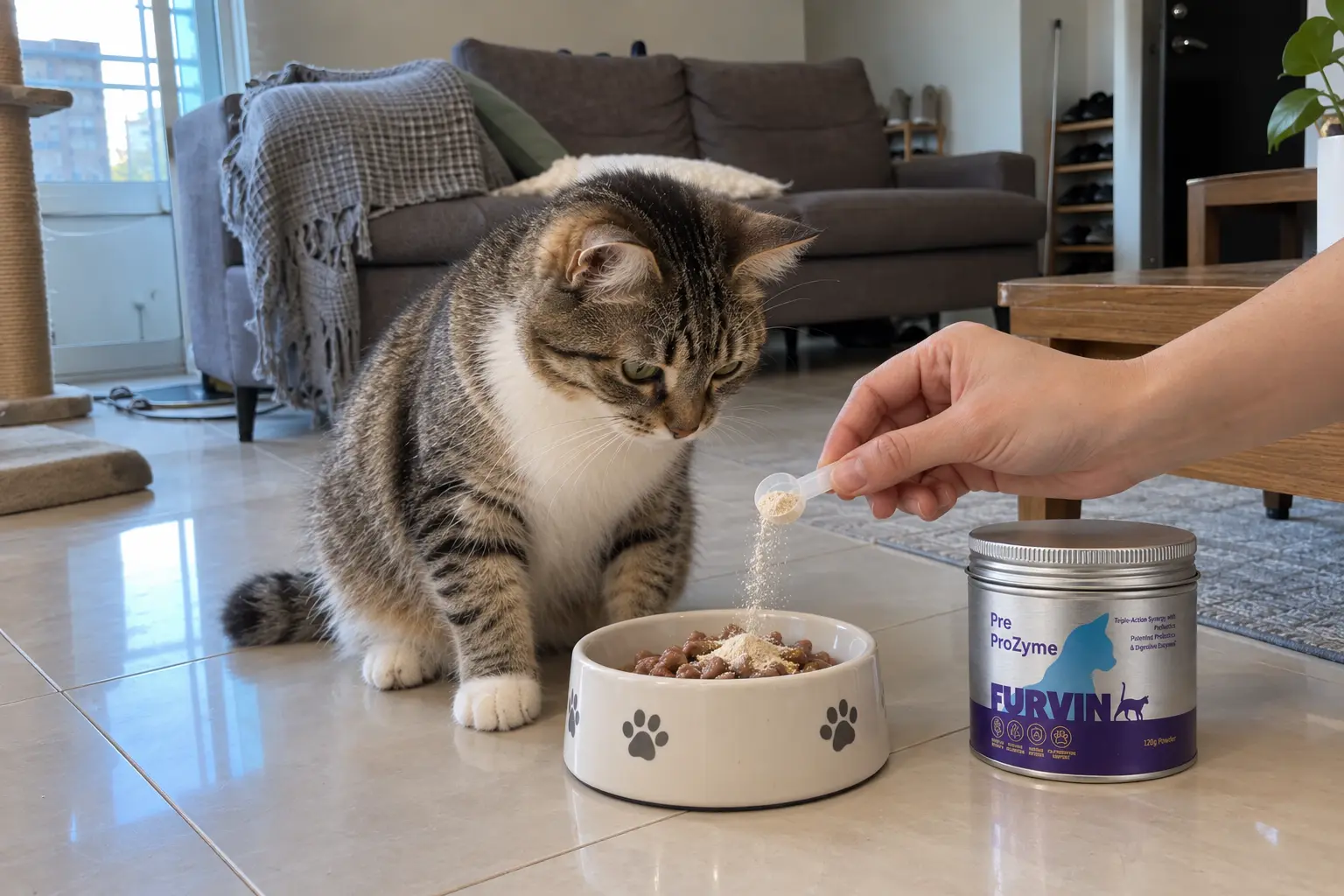
FURVIN PreProZyme is built around the same three-part digestive-wellness idea:
- 5.5 Billion CFU probiotics per 5 g serving from a proprietary multi-strain probiotic system
- inulin prebiotic to support the microbial environment
- five digestive enzymes - protease, cellulase, lipase, bromelain and papain - to support food breakdown
The wider formula contains supporting nutritional ingredients, but the central story remains simple:
PreProZyme is positioned as complementary inside-out support for digestive wellness, microbiome balance, nutrient utilisation and coat condition.
This is nutritional support rather than a drug, and it should not replace investigation or treatment of an underlying medical condition.
Which Type Should You Choose?
Start with the reason you are shopping.
For microbiome support
Look at the probiotic strains, CFU amount, product stability and evidence behind the strain selection - not CFU alone.
To support the gut environment
Look for a named prebiotic and follow the recommended amount. Increasing fermentable fibre too quickly can be uncomfortable for some cats.
For support around food breakdown
Check which enzymes are included and which food components they act on. Do not treat enzyme names as interchangeable with probiotics.
For one simple daily routine
A combined formula can bring the three roles together, provided the product facts are clear and the formula suits your cat.
Whatever you choose, follow the product directions and monitor appetite, stool consistency and your cat's general comfort.
When Should Your Cat See a Veterinarian?
A supplement is not the right first response to every digestive change.
Arrange veterinary care when signs are persistent, recurring or accompanied by:
- weight loss
- repeated vomiting
- blood in the stool
- very pale, greasy or unusually large-volume stool
- ongoing diarrhoea or constipation
- poor appetite
- marked lethargy
- dehydration
- abdominal discomfort
These signs can have many causes. The most useful next step is identifying the cause.
Frequently Asked Questions
Are probiotics and prebiotics the same thing?
No. Probiotics are selected live microorganisms. Prebiotics are substrates used by microorganisms in the host. They can be used together, but they perform different jobs.
Are more CFU always better for cats?
Not necessarily. CFU describes quantity. Strain selection, evidence, dose, stability and the cat's individual situation all influence whether a probiotic is a good fit.
Can cats take probiotics, prebiotics and digestive enzymes together?
Yes, they can be combined because their roles are complementary. A combined product should still provide clear ingredient information and feeding directions.
How quickly should I expect a change?
There is no single timeline for every cat. Response can vary with the cat, diet, reason for use and formula. Follow the feeding directions and assess trends rather than expecting an overnight transformation.
Do all cat probiotics need refrigeration?
No. Storage depends on the formulation and stability system. Follow the instructions on the specific product rather than applying one rule to every probiotic.
Can I give my cat a human digestive supplement?
Do not assume a human product is suitable for a cat. Ingredients, concentration, flavouring and serving size can differ. Use a cat-specific product or ask your veterinarian.
The Bottom Line
Probiotics, prebiotics and digestive enzymes belong in the same digestive conversation, but they are not the same tool.
- Probiotics support the microbial community.
- Prebiotics support the microbial environment.
- Digestive enzymes support food breakdown.
Once you know the difference, you can read product labels with a clearer purpose and choose a digestive-wellness routine more thoughtfully.
References / Sources
- The International Scientific Association for Probiotics and Prebiotics consensus statement on the scope and appropriate use of the term probioticNature Reviews Gastroenterology & Hepatology (2014)
Defines probiotics and explains why identity, dose and demonstrated benefit matter.
- The International Scientific Association for Probiotics and Prebiotics consensus statement on the definition and scope of prebioticsNature Reviews Gastroenterology & Hepatology (2017)
Sets out the current scientific definition of a prebiotic.
- The International Scientific Association for Probiotics and Prebiotics consensus statement on the definition and scope of synbioticsNature Reviews Gastroenterology & Hepatology (2020)
Clarifies how microorganisms and substrates may be combined in complementary or synergistic formulations.
- Efficacy of probiotic, prebiotic, synbiotic and postbiotic supplementation on gastrointestinal health in cats: systematic review and meta-analysisJournal of Small Animal Practice (2025)
DOI 10.1111/jsap.13822; PMID 39800337.
- Effects of Multi-Strain Probiotics on the Growth Performance, Serum Biochemistry, Intestinal Microbiome and Metabolome of CatsMetabolites (2023)
DOI 10.3390/metabo13020228; PMID 36837847.
- Effects of inulin on fecal microbiota and specific immunity in catsResearch in Veterinary Science (2024)
DOI 10.1016/j.rvsc.2024.105252; PMID 38564887.
- Effects of a combination of inulin and fructooligosaccharide on the fecal microbiota of healthy catsPeerJ (2017)
DOI 10.7717/peerj.3184; PMID 28439463.
- Exocrine Pancreatic Insufficiency in Dogs and CatsMerck Veterinary Manual
Veterinary reference reviewed September 2025; distinguishes diagnosed pancreatic insufficiency and therapeutic enzyme replacement from everyday wellness supplementation.