
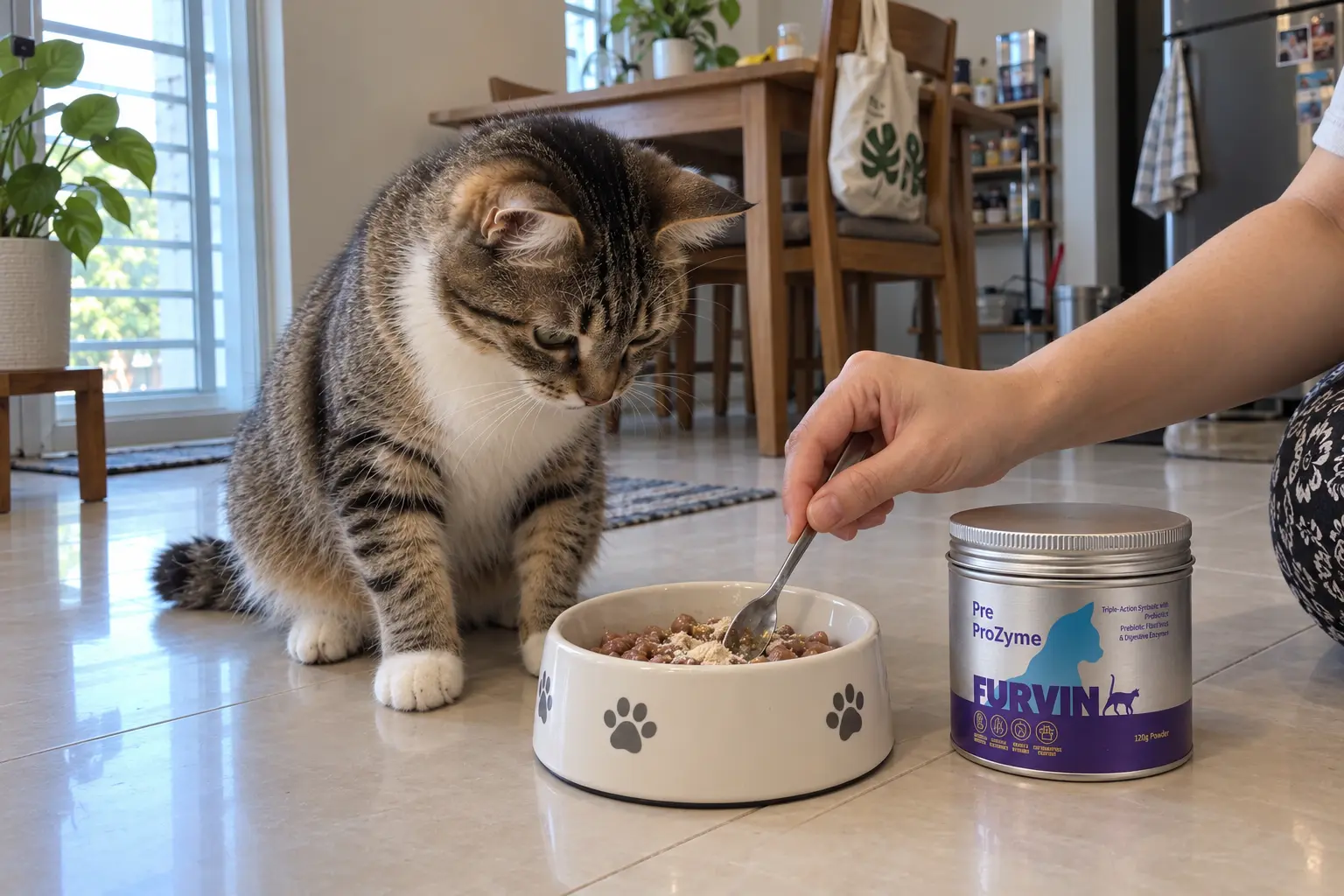
Probiotics make more sense as a routine than as a one-off “rescue scoop.” If the formula is made for cats, introduced gently and used according to its current label, daily use gives you a clearer, more repeatable way to support digestive wellness.
The 20-Second Answer
- Use the same measured serving: random amounts make results harder to judge.
- Keep the base diet steady: several changes at once create noise.
- Track stool, appetite and comfort: a trend is more useful than one good or bad day.
FURVIN PreProZyme is designed to make that routine simple: selected probiotics, prebiotic support and digestive enzymes together in one daily formula.
Why Daily Works Better Than “Only When Something Goes Wrong”
A probiotic is not simply any powder containing bacteria. The scientific definition centres on live microorganisms given in an adequate amount for a demonstrated benefit.[1] That means the microorganism, amount, formulation and way it is used all matter.
Feline studies have therefore used consistent daily supplementation over a defined period, rather than an occasional scoop:
- In one study, 15 healthy adult cats received a specific probiotic every day for 4.5 weeks; researchers reported changes in selected faecal bacteria and immune measures.[2]
- In another small study, 10 cats completed 28 days on either a control diet or a defined multi-strain probiotic. The probiotic group had higher faecal butyrate and total short-chain fatty acids, alongside changes in selected faecal inflammatory and antioxidant markers.[3]
These studies tested particular microorganisms and amounts—not every probiotic and not PreProZyme itself. But they show why daily consistency is part of the method, not an optional detail.
What the Wider Cat Research Says
A 2025 systematic review found that five of seven feline probiotic trials reported beneficial effects on faecal consistency. The authors also concluded that the overall evidence was not strong enough for high-confidence claims across every product and situation.[4]
A separate randomised, placebo-controlled trial followed 130 fostered shelter kittens. Under those specific study conditions, kittens given one feline-origin probiotic were less likely to develop diarrhoea than kittens given placebo.[5]
The useful takeaway is positive and practical:
- selected probiotics have produced favourable digestive findings in cats
- the result depends on the exact microorganism, amount, product and cat
- a clearly formulated daily routine is more meaningful than buying on the word “probiotic” alone
Make the First 14 Days Easy to Read
Days 1–3: Introduce gently
Mix the product into familiar food and follow the current label. For a selective or sensitive cat, a gradual introduction can make the new taste and routine easier to accept.
Days 4–7: Keep everything else boring
Use the same food, meal time and serving method where possible. Avoid adding several new treats or supplements during the same week.
Days 8–14: Look for the direction
Record stool consistency, appetite, acceptance, vomiting and general comfort. The aim is not to promise a result by a fixed day; it is to see whether the overall pattern is moving in a useful direction.
Where FURVIN PreProZyme Fits
Daily digestive support should be simple enough to repeat.
PreProZyme brings selected probiotics, prebiotic fibre and digestive enzymes into one measured feeding routine:
- Probiotics support the intestinal microbial community.
- Prebiotic support helps create a useful environment for selected beneficial bacteria.
- Digestive enzymes support the breakdown of food components.
That is the commercial advantage of the formula: you do not need to build a confusing stack of separate products or wait until the litter box becomes messy. One formula supports three connected parts of the digestive picture.
When to Call the Veterinarian First
Daily wellness support is most appropriate for a cat that is otherwise bright, eating and drinking normally. Contact a veterinarian promptly for watery or repeated diarrhoea, blood or black stool, repeated vomiting, pain, poor appetite, marked lethargy, dehydration or weight loss.[6]
Ask your veterinarian before adding a supplement when your cat is seriously unwell, medically vulnerable or taking treatment that may require specific timing.
Frequently Asked Questions
Can cats take probiotics every day?
Yes. Many healthy adult cats can use a cat-appropriate probiotic every day when it is introduced gently and given according to the current label. Consistency is usually more useful than giving it only after a digestive upset.
Should I stop when my cat's poop looks normal?
Not automatically. If the product is part of a daily wellness routine and your cat is doing well on it, normal stool can be a reason to keep the routine steady—not immediately change it again.
How long before I notice a difference?
Can I give my cat a human probiotic?
A cat-appropriate product is the clearer choice. Human products may use different microorganisms, amounts, flavourings, carriers or storage instructions. “More CFU” also does not automatically mean a better fit for a cat.
Can probiotics be used with antibiotics?
Often they can be part of a veterinarian-guided plan, but timing may matter because an antibiotic may affect susceptible probiotic organisms. Follow your veterinarian's or the product's instructions, and never stop a prescribed antibiotic on your own.
Can I use FURVIN PreProZyme every day?
Yes. PreProZyme is designed as a daily digestive-wellness routine. Mix the measured serving into familiar food, introduce it gradually if needed and follow the directions on your current pack.
The Bottom Line
Yes—cats can take a well-chosen probiotic every day. In fact, daily consistency is what turns a supplement from an occasional reaction into a routine you can evaluate.**
Choose a formula made for cats, keep the routine simple and watch the overall pattern. PreProZyme makes that easier by bringing probiotics, prebiotic support and digestive enzymes together in one feeding moment.
One daily habit. Three connected digestive roles.
References / Sources
- The International Scientific Association for Probiotics and Prebiotics consensus statement on the scope and appropriate use of the term probioticNature Reviews Gastroenterology & Hepatology (2014)
Defines probiotics and explains why microorganism identity, amount and demonstrated benefit matter.
- Effects of Lactobacillus acidophilus DSM13241 as a probiotic in healthy adult catsAmerican Journal of Veterinary Research (2006)
A 15-cat study using daily supplementation for 4.5 weeks; DOI 10.2460/ajvr.67.6.1005.
- Effect of a Multistrain Probiotic on Feline Gut Health through the Fecal Microbiota and Its Metabolite SCFAsMetabolites (2023)
A small 28-day study completed by 10 healthy adult cats; DOI 10.3390/metabo13020228.
- Efficacy of probiotic, prebiotic, synbiotic and postbiotic supplementation on gastrointestinal health in cats: systematic review and meta-analysisJournal of Small Animal Practice (2025)
Five of seven probiotic trials reported beneficial effects on faecal consistency, while overall certainty remained limited; DOI 10.1111/jsap.13822.
- Randomized placebo-controlled trial of feline-origin Enterococcus hirae probiotic effects on preventative health and fecal microbiota composition of fostered shelter kittensFrontiers in Veterinary Science (2022)
A product- and population-specific controlled trial completed by 130 shelter kittens; DOI 10.3389/fvets.2022.923792.
- Diarrhea in CatsVCA Animal Hospitals
Reviews severity, accompanying clinical signs and circumstances that need prompt veterinary attention.